Our head of maths has done a piece of work recently on RAG123 that I think I just have to share...
Firstly if you've never heard of RAG123 then look here for my original post on it, and then see here for all the others I've done...
Pupil voice
So far with RAG123 I've seen teacher definitions of what R,A,G mean, and what 1, 2, 3 mean, and we've occasionally had a go at doing a student oriented set of descriptors. However it surprises me to admit it but we've never previously asked the students to define it themselves!
With my stepping up to SLT this year I have had the pleasure of welcoming and line managing a new HoD to run the maths department. Simon Preston arrived at our school, inherited RAG123 from me and then he embraced it and used it for a while. Then he had a brainwave that is so obvious I don't know why nobody had thought of it before... He asked the students to define their understanding of all the RAG123 ratings...
Simon did this by issuing a sheet like the one below and asked the students to fill in the boxes with a description of what types of work or attitudes warranted each rating. Notably he didn't just ask them to define R, A, G and then 1, 2, 3, but he got them to define all 9 combinations of letters and numbers.
What did the students say?
I have been fascinated by the responses that the students gave. Having collated their inputs and drawn together the common themes Simon has compiled the following grid, which for me now seems to be the definitive RAG123 rating grid.
I think the nuance that the students have highlighted between R2 and R3 in the root cause for the low effort is really interesting. Also like the A1 "just enough". Overall I am really pleased by the clear linkage between effort and understanding. It all comes back to the basic position where students on 3 for understanding need clear input from the teacher to move them, and those on R for effort also need a decision from the student to improve.
Involving parents
Also this week we held a parent information evening for our yr 11 students where we were briefing them on revision techniques and ideas to improve home-school partnerships. This RAG123 grid was shared with parents and students in this session. We suggested that parents could work with students to RAG123 their revision processes at home in order to help figure out whether a session was effective or not. This was really well received and we have had several positive comments from parents about this giving them the tools to help review progress with revision, particularly in subjects that they have no expertise in.
Have you done something similar?
The idea of asking the students is so obvious I'm amazed I or someone else haven't already done it - does anyone else have a similar student perspective on RAG123? If you have I'd be really keen to see it.
Once again - if you've not tried RAG123 you don't know what you're missing in terms of building linkage between marking and planning, building dialogue with students and the promoting growth mindset type linkages between effort and progress. Give it a try and let me know how it goes!
Showing posts with label Revision. Show all posts
Saturday, 31 January 2015
Saturday, 14 December 2013
Using SOLO in a maths classroom
I've blogged on SOLO before (here and here), and it's still very early days in rolling this out beyond a few experiments, but it's working and developing...
Here are a few of the things we've been trying...
SOLO to structure revision:
The hierarchy of understanding that SOLO brings is a natural match to structuring revision. In helping my year 9 middle ability group to prepare for a test I put together some sheets that tried to help them to collect and organise their knowledge & skills.
I used SOLO to guide them trough it:
I tried this with the class with only a limited explanation of the stages - just presented them with the sheets and encouraged them to use their notes or other resources in the room to help get from Prestructural to Relational, pushing to Extended abstract where possible. The students reacted in a really positive way - they really liked the way they could demonstrate increasing understanding. The weaker students also liked that they could demonstrate some understanding even if they couldn't get all of the way to the bottom of the sheet. They recognised that they needed to find more of the multistructural facts and link them up in order to answer the questions posed. As a result I will definitely be using this approach again with this group.
More advanced revision
I have also started using a similar approach with my year 13 group. Initially this was a relatively informal process, with the SOLO icons scribbled on the board and student lead notes being made in class. Like this:
Following the success of the year 9 sheets, and a good response from the A-level students I've now got to the next step and created some proper A-level revision sheets - like this:
Tried it out with yr 13 on Friday - again a really positive student response, meaning I'll create more.
SOLO as a problem solving tool
I've also used SOLO a few times to help students to solve unfamiliar problems. For example without actually teaching anything about arc length or sector areas I put this slide up on the board:
The class then followed a "Think, Pair, Share" type activity to generate enough facts, individually and as a whole class. They then linked them up to allow the problem to be solved.
The second slide (arc length) needed much less discussion as the class had already accessed the key facts, and reached the solution more quickly.
Form there, without me actually telling the class how to do it at any point in the lesson, they all went on to confidently answer a range of questions relating to arc lengths and sector areas.
SOLO as a starter
We've also looked at using SOLO to collect prior knowledge on a topic at the start of a lesson. This can be really useful with a new group, or when coming across a topic that you've not touched on with a group before. Just put the icons on the board, write the topic name next to the prestructural blob and then see what facts the students can give to you and what links they can make between the facts.
SOLO as a Plenary
Part way through a lesson or at the end - just ask the students where on the SOLO taxonomy they think they are, how they know that and what they need to do to move to the next level - they soon get the hang of the icons and the conversations are great.
How are you using SOLO?
Do you have any comments or suggestions - I'm really keen to know how others are using SOLO in maths and in other areas - please comment or drop me a line on twitter.
Here are a few of the things we've been trying...
SOLO to structure revision:
The hierarchy of understanding that SOLO brings is a natural match to structuring revision. In helping my year 9 middle ability group to prepare for a test I put together some sheets that tried to help them to collect and organise their knowledge & skills.
I used SOLO to guide them trough it:
- Prestructural - do they remember that we've covered that topic?
- Unistructural - can they remember one fact about it?
- Multistructural - can they remember any more facts about it?
- Relational - can they combine these facts to answer some questions about it?
- Extended Abstract - are there any links to other things that will help them to remember the key points?
I tried this with the class with only a limited explanation of the stages - just presented them with the sheets and encouraged them to use their notes or other resources in the room to help get from Prestructural to Relational, pushing to Extended abstract where possible. The students reacted in a really positive way - they really liked the way they could demonstrate increasing understanding. The weaker students also liked that they could demonstrate some understanding even if they couldn't get all of the way to the bottom of the sheet. They recognised that they needed to find more of the multistructural facts and link them up in order to answer the questions posed. As a result I will definitely be using this approach again with this group.
More advanced revision
I have also started using a similar approach with my year 13 group. Initially this was a relatively informal process, with the SOLO icons scribbled on the board and student lead notes being made in class. Like this:
Following the success of the year 9 sheets, and a good response from the A-level students I've now got to the next step and created some proper A-level revision sheets - like this:
Tried it out with yr 13 on Friday - again a really positive student response, meaning I'll create more.
SOLO as a problem solving tool
I've also used SOLO a few times to help students to solve unfamiliar problems. For example without actually teaching anything about arc length or sector areas I put this slide up on the board:
The class then followed a "Think, Pair, Share" type activity to generate enough facts, individually and as a whole class. They then linked them up to allow the problem to be solved.
The second slide (arc length) needed much less discussion as the class had already accessed the key facts, and reached the solution more quickly.
Form there, without me actually telling the class how to do it at any point in the lesson, they all went on to confidently answer a range of questions relating to arc lengths and sector areas.
SOLO as a starter
We've also looked at using SOLO to collect prior knowledge on a topic at the start of a lesson. This can be really useful with a new group, or when coming across a topic that you've not touched on with a group before. Just put the icons on the board, write the topic name next to the prestructural blob and then see what facts the students can give to you and what links they can make between the facts.
SOLO as a Plenary
Part way through a lesson or at the end - just ask the students where on the SOLO taxonomy they think they are, how they know that and what they need to do to move to the next level - they soon get the hang of the icons and the conversations are great.
How are you using SOLO?
Do you have any comments or suggestions - I'm really keen to know how others are using SOLO in maths and in other areas - please comment or drop me a line on twitter.
Monday, 7 October 2013
More flipping homework
Quick follow up to this post...
Middle set pupil voice
My set 3 year 11 LOVED the flipped approach. All watched the video (I planned strategic questions to check they had done), all nailed the related questions on a topic I'd not covered at all in class.
In addition they all had a look at another video of their own choice. Some looked at topics we'd covered before, others looked ahead at higher/extension topics and were able to give some key facts about them.
Across the class the students used all 3 methods of finding the links that I gave them - some typed them in, some clicked through a PDF hyperlink, and others used the QR codes.
When asked if they would like more homework set like that they all answered "YES".
Top set pupil voice
By contrast my very high ability top set year 10 really didn't like the flipped approach. They said they struggled to get on with the videos, and found them either confusing, patronising or just not very helpful (it was on a topic that I had spotted they were struggling with based on an earlier homework - the video covered all of the key bits of information that they needed to resolve the issues I had seen previously).
They all said they would prefer to be guided to a page in a textbook or revision guide than to use videos, and didn't really want me to set homeworks like this again.
A conjecture
Based on this spectacularly small sample I'm now wondering... Do we have a situation where the weaker students like the more prescriptive, didactic approach of an instructional video; and those with greater confidence in maths prefer support that allows them to gather information for themselves and use that to shape their approaches without straight instruction?
This is one off snapshot of data - the stark difference between the two classes stood out for me and hence raised the question. I need to look at how other classes in my school took to this approach to add or detract from my conjecture.
I'd be interested to hear if you have experiences that might agree or disagree with what I have found so far...
Middle set pupil voice
My set 3 year 11 LOVED the flipped approach. All watched the video (I planned strategic questions to check they had done), all nailed the related questions on a topic I'd not covered at all in class.
In addition they all had a look at another video of their own choice. Some looked at topics we'd covered before, others looked ahead at higher/extension topics and were able to give some key facts about them.
Across the class the students used all 3 methods of finding the links that I gave them - some typed them in, some clicked through a PDF hyperlink, and others used the QR codes.
When asked if they would like more homework set like that they all answered "YES".
Top set pupil voice
By contrast my very high ability top set year 10 really didn't like the flipped approach. They said they struggled to get on with the videos, and found them either confusing, patronising or just not very helpful (it was on a topic that I had spotted they were struggling with based on an earlier homework - the video covered all of the key bits of information that they needed to resolve the issues I had seen previously).
They all said they would prefer to be guided to a page in a textbook or revision guide than to use videos, and didn't really want me to set homeworks like this again.
A conjecture
Based on this spectacularly small sample I'm now wondering... Do we have a situation where the weaker students like the more prescriptive, didactic approach of an instructional video; and those with greater confidence in maths prefer support that allows them to gather information for themselves and use that to shape their approaches without straight instruction?
This is one off snapshot of data - the stark difference between the two classes stood out for me and hence raised the question. I need to look at how other classes in my school took to this approach to add or detract from my conjecture.
I'd be interested to hear if you have experiences that might agree or disagree with what I have found so far...
Saturday, 28 September 2013
Flipping homework!
I've read lots about flipped learning, via the likes of Bruno Reddy (@mrereddymaths) here, and Colin Hegarty (@hegartymaths) here. I like the concept but have never tried it myself... until now.
Not fully flipped but encouraging independence
This week's homeworks have all contained internet links to different resources.
One class had a link to some of the Hegartymaths videos to give them support with a topic I know they've struggled with, and then included some related exam questions. Another class had links to information about a topic we've not covered before, and the homework sheet required them to answer key questions about the topic (and the resource), then answer some questions.
Both of these classes included an extra task to find out about another GCSE topic and tell me 3 key facts about it.
To help the students to access the resources the sheets included the full internet link, they were given access to a PDF copy with a working hyperlink, and I also put on a QR code in case they wanted to scan it with a phone/tablet.
An example of one of the homeworks is as follows:
I'd be keen to hear about others using this kind of thing and any other ideas you might have to make it more effective. As always all comments welcome.
Not fully flipped but encouraging independence
This week's homeworks have all contained internet links to different resources.
One class had a link to some of the Hegartymaths videos to give them support with a topic I know they've struggled with, and then included some related exam questions. Another class had links to information about a topic we've not covered before, and the homework sheet required them to answer key questions about the topic (and the resource), then answer some questions.
Both of these classes included an extra task to find out about another GCSE topic and tell me 3 key facts about it.
To help the students to access the resources the sheets included the full internet link, they were given access to a PDF copy with a working hyperlink, and I also put on a QR code in case they wanted to scan it with a phone/tablet.
An example of one of the homeworks is as follows:
Early indications are good
I've not yet collected all of the homeworks - not due until Tuesday. However I've already had some submitted to me, and I'm really impressed at the results.
The students have grasped the key points about the main bit of the homework, and when questioned were able to go into reasonable detail.
What's more interesting though is the extra "choose your own" bit. They've chosen very different topics, none of which I've actually covered in lesson before. The 3 key points given clearly demonstrate that they have understood the new content to a reasonable extent.
Not making the classroom redundant
I should be clear that I will re-cap and double check any understanding gained via independent work to make sure it is sound and not riddled with misconceptions or really superficial. However I do think this is really powerful as a way to either consolidate a topic or introduce a new one and get a foothold on a tricky topic.
Doesn't just have to be videos
Of course I know that some people dislike the video tutorial - think the objections are along the lines that they are too didactic, possibly not engaging enough or encouraging enough deep thought? The same people are usually highly anti-textbook. While I do recognise this argument I also think there is a valid place for the straight tutorial alongside other teaching methods and approaches. For some students a traditional "chalk and talk" approach really is the best thing to do to maximise their exam performance.
It certainly seems to me that online videos can be very effective, and so far the students do seem to engage with it very well. However I should be clear that don't plan to use the same source or type of links every week.
Sometimes I'll be linking to our online textbook resources, other times tutorial videos, other times it might be a google doc or padlet to contribute to, a news item that might be relevant, and there are a few other ideas that I need to flesh out... The power of the internet is that there are just so many different types of resources out there that it is always possible.
Taxonomy of errors
A key thing I'm really interested by is that this approach makes response to individual student's needs far easier. This links nicely to the "taxonomy of errors" approach proposed by Keven Bartle (@kevbartle) in this post.
By spotting patterns in the mistakes made by students I plan to be able to personalise homeworks and responses far more by guiding the students to particular resources based on their needs. This kind of personalisation has always been a real challenge for me to do effectively without spending hours and hours creating the right resources, however using the power of the internet I think it becomes far more accessible.
Early days
As with many of my posts - this is early days and I'm going to keep an eye on how it progresses. Several of my department are also pushing this and developing it so there will be a large amount of feedback in a relatively short period of time.
I'd be keen to hear about others using this kind of thing and any other ideas you might have to make it more effective. As always all comments welcome.
Saturday, 14 September 2013
Rockets to A Stars
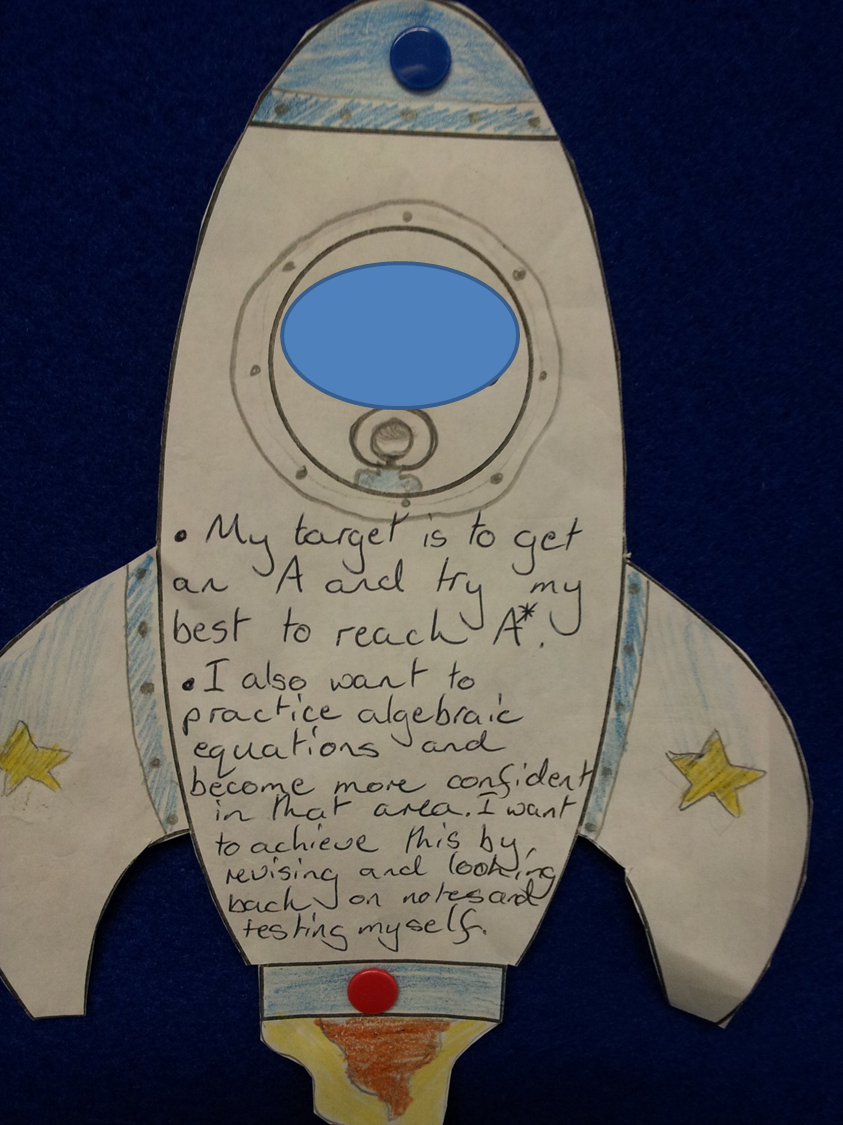
Something that one of our teachers is doing with their group - I really liked the idea so thought I'd share it...
Target centered display
One of our top set groups has this on the wall of their classroom:
Each student has a rocket, and there is also a rocket on there for the teacher. The teacher's declared target is to exceed the school record of 10 A* grades at GCSE. It's worth noting that this group has only has one student with an FFTD target of A*, the rest are A and B grade targets so this is a stretchy target to go after, but the way the group are progressing it is realistic (last year we had a target of 2 and delivered 10 so we have a precedent too).
Each student has been given a list of key A* topics loosely based on these excellent passports by Mr Slack. They have self-assessed on these lists and chosen one to focus on initially, and then written these as targets on their rocket... here are 5 examples:
Target centered display
One of our top set groups has this on the wall of their classroom:
Each student has a rocket, and there is also a rocket on there for the teacher. The teacher's declared target is to exceed the school record of 10 A* grades at GCSE. It's worth noting that this group has only has one student with an FFTD target of A*, the rest are A and B grade targets so this is a stretchy target to go after, but the way the group are progressing it is realistic (last year we had a target of 2 and delivered 10 so we have a precedent too).
Each student has been given a list of key A* topics loosely based on these excellent passports by Mr Slack. They have self-assessed on these lists and chosen one to focus on initially, and then written these as targets on their rocket... here are 5 examples:
Hopefully you will notice that the students are identifying how they will achieve their target as well.
Tracking progress
Shortly all of the rockets will be re-grouped at the bottom of the board, and the challenge will be that they climb up the board "towards the stars" by ticking off completed targets.
To mark a target as completed firstly they will need to do some work on the topic they have identified. Then they need to show their work to a classmate who will peer assess and decide whether they think they have mastered the topic. Only once the self and peer assessment is completed do the students then ask the teacher to tick off that topic - then they can move their rocket upwards.
Then they select a new topic, add this to their rocket and the cycle repeats.
Not for everyone
This approach requires the students to be fairly self motivated, but hopefully the visible nature of this will also encourage those that are a little more reluctant. Certainly the enthusiasm of the teacher involved and the outstanding relationship she has established with the students will also help.
Lets see if it works
If this can help us to deliver a few more A* grades for students then this approach certainly can't hurt. Even if they "only" get grade As it's still a fantastic idea. Importantly by asking the students to write down both what and how they are going to do this it requires a level of buy in that wouldn't be there otherwise.
I'm really looking forward to watching this develop - it looks like a great idea and will be the first to congratulate the teacher and students if it helps them to achieve their school record aims.
As always all thoughts welcome...
Saturday, 31 August 2013
A toolbox to help start your term
UPDATED JAN 2014. - Adding in #RAG123 info and updating download data.
I've posted at various points over the last few months about using common formats, excel sheets or tools to help make some aspects of day to day teaching easier. It's not about making everyone's teaching the same, it's about giving a basically good structure to help save time and allow outstanding teaching to flourish around it. A background to this philosophy can be found here in my very first post.
I thought it might be useful to collect the main bits together in one place with a bit of commentary, and I've also shared publicly a couple of the formats that I've not shared previously... Realise this is a bit of a clip show of a post, but hopefully it is also useful.
Transform your marking with #RAG123
Counter-intuitive it may be, but marking more often really can reduce your workload and have real value for students. I can't emphasise enough how much impact this has had on my day to day teaching and also helping to manage my workload. Powerpoint explaining the key points can be found in this post.
Seating plans
Seating plans are deceptively powerful and can be used as an assessment and monitoring tool as well as a way to manage behaviour. However the more data you put in the harder it is to change the plan at a later date - this is a tool to help with that... In this post I explained the thinking behind this sheet - basically it allows you to create and modify seating plans easily and include useful bits of student data at the same time.
The proforma is here. (over 800 downloads on TES as of Jan 2014)
Markbook and feedback proforma
The process behind creating this sheet is explained in this post - the resource is a feedback sheet that has been used in my department to transform the quality of feedback & marking, as described in this post.
I've not shared the proforma before, but it's now available for download here. (downloaded over 400 times on TES as of Jan 2014)
Formats for giving summative tests/assessment formative impact.
As discussed in this post and this post I really value testing in my department, but it's got to be about more than just grades and levels. The following resource allows analysis of any exam, assessment or test. I've even used it in the past to give feedback to book marking but that's been superseded by the feedback proforma above. I find this type of analysis really powerful and the students at our school also find them useful.
I've not shared this widely before, but again it's now available for download here. (downloaded over 150 times on TES as of Jan 2014)
Regular testing followed by good analysis and formative feedback has resulted in our department posting a second consecutive record year of results at GCSE. This year was the first time ever that the school's maths results passed 70% A*-C, with an overall figure of 76.8%. You can see how regular mocks and feedback led to improvement in the graph that tracked our progress during the year...
Prompts for questioning linked to SOLO
This has been one of my most popular posts ever, and the resource has been downloaded on TES over 360 times as of Jan 2014. You can find the sheet here.
Other SOLO resources can be seen here.
Sharing learning objectives with KS5
Sometimes I find it difficult to share learning objectives in a meaningful way with KS5 students - I've found this format useful as explained in this post. The format for the logs can be found here. (over 70 downloads as of Jan 2014).
Make yourself some promises for the start of term
As a HoD or as a classroom teacher it is good to take a few moments to reflect and make yourself some promises. I've explained the thinking behind the formats in this post, and the documents themselves are available here. (over 130 downloads as of Jan 2014).
Other tips to help this year to be better than the next
1) Get on twitter... why? see this post...
2) Do something different in your classroom - here are some ideas
3) If you want something to improve - find a good way to measure it an make it visible - as explained here.
4) Run a departmental open day - you'll get way more from it that you might expect. Details on our first ever one can be found here.
I hope that this coming academic year will be good to you and your students - if you have any other good ideas please do share them.
I've posted at various points over the last few months about using common formats, excel sheets or tools to help make some aspects of day to day teaching easier. It's not about making everyone's teaching the same, it's about giving a basically good structure to help save time and allow outstanding teaching to flourish around it. A background to this philosophy can be found here in my very first post.
I thought it might be useful to collect the main bits together in one place with a bit of commentary, and I've also shared publicly a couple of the formats that I've not shared previously... Realise this is a bit of a clip show of a post, but hopefully it is also useful.
Transform your marking with #RAG123
Counter-intuitive it may be, but marking more often really can reduce your workload and have real value for students. I can't emphasise enough how much impact this has had on my day to day teaching and also helping to manage my workload. Powerpoint explaining the key points can be found in this post.
Seating plans
Seating plans are deceptively powerful and can be used as an assessment and monitoring tool as well as a way to manage behaviour. However the more data you put in the harder it is to change the plan at a later date - this is a tool to help with that... In this post I explained the thinking behind this sheet - basically it allows you to create and modify seating plans easily and include useful bits of student data at the same time.
The proforma is here. (over 800 downloads on TES as of Jan 2014)
Markbook and feedback proforma
The process behind creating this sheet is explained in this post - the resource is a feedback sheet that has been used in my department to transform the quality of feedback & marking, as described in this post.
I've not shared the proforma before, but it's now available for download here. (downloaded over 400 times on TES as of Jan 2014)
Formats for giving summative tests/assessment formative impact.
As discussed in this post and this post I really value testing in my department, but it's got to be about more than just grades and levels. The following resource allows analysis of any exam, assessment or test. I've even used it in the past to give feedback to book marking but that's been superseded by the feedback proforma above. I find this type of analysis really powerful and the students at our school also find them useful.
I've not shared this widely before, but again it's now available for download here. (downloaded over 150 times on TES as of Jan 2014)
Regular testing followed by good analysis and formative feedback has resulted in our department posting a second consecutive record year of results at GCSE. This year was the first time ever that the school's maths results passed 70% A*-C, with an overall figure of 76.8%. You can see how regular mocks and feedback led to improvement in the graph that tracked our progress during the year...
Prompts for questioning linked to SOLO
This has been one of my most popular posts ever, and the resource has been downloaded on TES over 360 times as of Jan 2014. You can find the sheet here.
Other SOLO resources can be seen here.
Sharing learning objectives with KS5
Sometimes I find it difficult to share learning objectives in a meaningful way with KS5 students - I've found this format useful as explained in this post. The format for the logs can be found here. (over 70 downloads as of Jan 2014).
Make yourself some promises for the start of term
As a HoD or as a classroom teacher it is good to take a few moments to reflect and make yourself some promises. I've explained the thinking behind the formats in this post, and the documents themselves are available here. (over 130 downloads as of Jan 2014).
Other tips to help this year to be better than the next
1) Get on twitter... why? see this post...
2) Do something different in your classroom - here are some ideas
3) If you want something to improve - find a good way to measure it an make it visible - as explained here.
4) Run a departmental open day - you'll get way more from it that you might expect. Details on our first ever one can be found here.
I hope that this coming academic year will be good to you and your students - if you have any other good ideas please do share them.
Saturday, 29 June 2013
Some of the things we've been doing
As observed in earlier posts - we've been busy in the department over the last couple of years seeking improvements in all sorts of ways. In all of the posts so far I've mentioned several fairly structural ways we've been making changes and improvements, but haven't really done much regarding some of the classroom approaches we've been using.
So here are 5 suggestions of things we've done, with examples & pictures of how we've used them.
Some of these are ideas proudly magpied from various places (twitter being a big one!), others we came up ourselves with but of course they could easily have been in existence elsewhere. I'm not crediting sources here not because I am claiming them for myself - it's just because we've lost track of where these ideas have come from. If you feel strongly about ownership of any of these ideas then please feel free to claim anything via the comments at the bottom.
1) Graffiti revision wall
Get some lining paper, or some other big sheet of paper to put up somewhere in your room to use for this.
While revising if a student finds something that they think would be useful to them, or someone else in the class in the future or they can go and write it on the board. If they are uncomfortable writing it up directly they can ask me to do it (though they have to say exactly what to write) or put in on a smaller piece of paper that is then glued on. Also of a student feels they can explain an idea in a better way they can replace work on the board by sticking a replacement over the top.
After a week or so mine looked like this:
One of our SLT saw it on the wall and made a quip about me "not being at college when they covered display work." I pointed out that it's meant to be dynamic, organic and USEFUL, not pretty! He accepted the point!
I ran it with two fairly low ability groups and they liked the fact that they could control what went up on the board, and that they could refer back to it when they needed. it was really nice to see it develop over a series of weeks.
2) Question boards
Similar vein to the graffiti wall but not quite so imposing. We have had different versions running in the department.
One looks like this:
When a student in the class asks a question and then finds out an answer they write their question and their name on the post-it. If another student in the class asks the same question they are directed to the board to find out who in the class knows the answer so they can go and ask them. Here are some examples:
This helps to remove the perception that the "teacher is the holder of all facts", and encourages sharing of info between students.
Another alternative is this:
3) Student comments on display work
Again making displays interactive. Work is done for display and then put on the wall. The students are then encouraged to comment on the work with post-its that are added to the display. Where appropriate the teacher can clarify or add to comments made by adding an extra, different coloured post-it.
The whole effect looks like this (student comments in yellow and orange, teacher comments are the green arrows):
The students provide some interesting feedback to each other:
4) Use more of the classroom as a whiteboard
I've seen several people suggesting using windows as whiteboards - we've used them with students writing on them like this:
Teachers have also used them to pose questions (different questions on different windows - for differentiated tasks) - like this:
If you've not got windows that are suitable/accessible then you can get a product called "instant whiteboard". It comes on a roll and sticks to almost any surface like clingfilm. Students can use it to discuss and share ideas:
Or teachers can use it to set work for a specific group of students:
So here are 5 suggestions of things we've done, with examples & pictures of how we've used them.
Some of these are ideas proudly magpied from various places (twitter being a big one!), others we came up ourselves with but of course they could easily have been in existence elsewhere. I'm not crediting sources here not because I am claiming them for myself - it's just because we've lost track of where these ideas have come from. If you feel strongly about ownership of any of these ideas then please feel free to claim anything via the comments at the bottom.
1) Graffiti revision wall
Get some lining paper, or some other big sheet of paper to put up somewhere in your room to use for this.
While revising if a student finds something that they think would be useful to them, or someone else in the class in the future or they can go and write it on the board. If they are uncomfortable writing it up directly they can ask me to do it (though they have to say exactly what to write) or put in on a smaller piece of paper that is then glued on. Also of a student feels they can explain an idea in a better way they can replace work on the board by sticking a replacement over the top.
After a week or so mine looked like this:
One of our SLT saw it on the wall and made a quip about me "not being at college when they covered display work." I pointed out that it's meant to be dynamic, organic and USEFUL, not pretty! He accepted the point!
I ran it with two fairly low ability groups and they liked the fact that they could control what went up on the board, and that they could refer back to it when they needed. it was really nice to see it develop over a series of weeks.
2) Question boards
Similar vein to the graffiti wall but not quite so imposing. We have had different versions running in the department.
One looks like this:
When a student in the class asks a question and then finds out an answer they write their question and their name on the post-it. If another student in the class asks the same question they are directed to the board to find out who in the class knows the answer so they can go and ask them. Here are some examples:
This helps to remove the perception that the "teacher is the holder of all facts", and encourages sharing of info between students.
Another alternative is this:
Students use a small piece of paper either to write a short guide on a key topic (with an example), like this:
Alternatively they can write a question that's puzzling them and others in the class can go up and answer them, like this:
3) Student comments on display work
Again making displays interactive. Work is done for display and then put on the wall. The students are then encouraged to comment on the work with post-its that are added to the display. Where appropriate the teacher can clarify or add to comments made by adding an extra, different coloured post-it.
The whole effect looks like this (student comments in yellow and orange, teacher comments are the green arrows):
4) Use more of the classroom as a whiteboard
I've seen several people suggesting using windows as whiteboards - we've used them with students writing on them like this:
Teachers have also used them to pose questions (different questions on different windows - for differentiated tasks) - like this:
If you've not got windows that are suitable/accessible then you can get a product called "instant whiteboard". It comes on a roll and sticks to almost any surface like clingfilm. Students can use it to discuss and share ideas:
Or teachers can use it to set work for a specific group of students:
5) Key word bank
Only actually used in one of our classrooms but I'm looking to spread it further. Think primary schools use this type of thing a lot.
Fairly self explanatory - it looks like this...
6) Measuring progress against revision topics
This is another one that is supposed to be dynamic and USEFUL rather than pretty!
Linked heavily to the "passport to grade" resources by Mr Slack found here, but could be used with any topic list. Key topics displayed on the wall. When a student demonstrates proficiency in a topic they get a stamp in their passport and can go and sign the wall next to the topic. They then become an expert on that topic so if others in the class need help they can look at the wall and go and ask the relevant student.
After a few lessons it looked like this:
The students liked signing up and seeing their names up on the board. Next time I do this I was thinking of having key assessment/example questions for each topic attached next to the topic name. Might also include a QR code linking to online revision resources.
Hope this was useful
Hopefully you've seen something you might use, or perhaps it gave you an idea for something else? Either way - all thoughts & comments gratefully received.
Monday, 17 June 2013
Lesson logs - Sharing objectives and prompting reflection for KS5
For me KS5 lessons always feel like they need a slightly different approach to sharing learning objectives compare to those lower down the school. Maybe it's just my perception but the students seem to want a different approach to signify that they are more mature. Taking the same approach as used for KS3 and 4 always felt a bit patronising. Similarly getting them to reflect on their learning in a meaningful way was always a bit of a challenge.
Anyway I was struggling on with this for a while and then I remembered a sheet that had been shown by a chap called Jonathan Briggs from the school I taught at in my NQT year. I dusted off a copy of his sheet, and tweaked/adjusted it until I was happy with it.
Learning log document
The result is a "Learning log" and it looks like this...
How I use it
At the start of each section of work (usually 2-3weeks worth) I fill in the top "What we're working towards" section with a brief description of the main topic, the goals and the assessment that will be used.
At the start of each week I then fill in the "Objectives" and "Outcomes" section of the "What I am doing this week" bit. This breaks down the bigger picture into a one week set of learning objectives. The students get a printed copy handed to them at the start of the week.
At the end of some lessons and at the week I ask the students to do a final rating of their progress, complete the reflection section at the bottom and also fill in the "What I still need to do" bit. To be completely honest I don't police this bit heavily - it is mainly for them to use to structure their work outside of lessons, but the fact I ask them to do it means they're at least thinking about it.
The "Progress" bit can be completed by the student - I've rarely insisted on detailed completion of this as on a week by week basis this doesn't really change drastically, however I don't really feel comfortable just deleting it yet - not sure why. Guess If I wanted to get flash with it I could set up a mailmerge of student targets and latest assessment data to personalise the sheets, but I've never got that far.
As well as tracking objectives and reflection the students are encouraged to use these sheets as page dividers for their work. I also use them with students that are absent for lessons as they can see the learning objectives that they need to review & study to catch up for the missed lessons.
Impact
I tried it with my Year 13 group last year and they said they found them useful. They even asked where they were when I didn't hand them over at the start of the lesson one Monday due to a problem with the school printers.
I also found them useful as part of my planning as it caused me to have a much more detailed think about how each chunk of work breaks down into learning objectives on a week by week basis.
I have no real way to measure whether they were effective in terms of grades or understanding, but the fact that the students said they liked them and I found them useful for planning is enough to make me carry on. I also take the view that even if they have no tangible benefit they are very unlikely to actually do harm to progress!
I am now asking my department to run with this across all KS5 lessons for the coming academic year
Get a copy
If you would like a copy of this sheet then you can get one here.
Feedback welcome
Is this useful? Do you do something similar? Have you got an alternative that's better? All thoughts appreciated.
Saturday, 11 May 2013
Things we've done to help year 11
This post is nothing to do with managing variability other than these are actions that have been taken across the department during the past year or so, and as such are shared core practice within our team... I just wanted to record all of the things we've done with our current year 11 that have contributed to a substantial improvement in results this year.
Some may seem obvious, others less so, but all have made a contribution.
1) Establish a progress measure and make it visible to staff and students
We started mock exams with full papers early in the academic year, assigning grades and sharing them with the students and staff. We then did these regularly throughout the year, progressing through different past papers. Early scores were low due to bits of missing content, but we could also identify gaps in knowledge of content we had already covered. All mocks were accompanied by formative feedback & self assessment as discussed in my earlier post. this is in addition to feedback given on book work, which is also a subject of an earlier post.
Tracking this data centrally made the department staff aware of where work was required with particular students. You can see the progress made at a headline level during the year below, but the data was held at an individual student and class level. We could cut it to look specifically at SEN, FSM or other raise groups as well as general progress:
(You may be thinking that these results don't look that impressive?
Yes I know we're still below the target line, but we've not finished the year yet! - we've got more students within reach of a C taking exams in June - this should close the gap and take us up to, and hopefully even past the target line - I'm also keen to point out that it's not all about C grades either - we had a target of just 2 A* grades this year but have already recorded 10 so far.
I'll agree that we're not yet posting results at a level that would put us at the top of league tables, however the school has been posting results in the mid 60% range for the last 6 years, with similar target levels to this year! Therefore to take a step into the mid-high 70%, or even 80% range by the time the summer results are in will be a big improvement, and the best the school has ever delivered.)
We had actually done this regular mock process with this year group during year 10 in preparation for their earlier unit exams, so they were used to the idea of seeing progress their develop during the year.
As well as nicely sloping graphs we posted visual summaries of individual student performance vs target grades in classrooms and talked about a path to improvement. Note that because some students were concerned about publicly displaying low targets or low grades we didn't talk about actual grades, just position vs their personal target via colour coding. This is an example of what they look like:
By keeping these sheets visible in every classroom and doing the regular mocks we were emphasising that the important thing to see during the year is progress towards targets, not necessarily step changes to target. Students were always keen to see how their colours developed as the mocks progressed.
I acknowledge it's not neat & tidy and doesn't show a flawless progression from red to green/blue, but real data often isn't. However it is clear for the students to see the progress they and their peers have made during the year, which is substantial.
2) Carefully targeted revision support
Where groups of students share a common need in terms of revision then we re-grouped them to maximise focus on these areas of weakness - this happened within classes as part of differentiation and also across classes where students were grouped with a particular teacher for a short time according to need.
We also selected some students for 1:1 withdrawal during lessons (including selected extraction from other subjects for those most in need), and also selected some for short 1:1 sessions during morning registration.
3) Be clear about what is required to reach or exceed targets
We used analysis of past grade boundaries and conversions to recommend minimum marks required to achieve both their target grade and the grade above. The students responded really well to knowing that they needed a particular score, and again this helped them to judge progress in mocks. e.g. if Johnny needed at least 55 for an overall grade B, and scored 34 then 45 in successive mocks he could see progression towards his personal target in a clearer way than two grade Cs would have.
4) Parental involvement
I've already mentioned parental involvement in homeworks in an earlier post, and this did help to push the visibility of maths as a subject at home and in class.
Communications home in addition to the homework information included notification of after school and half term/holiday revision sessions, early details of exam dates and expected equipment.
Ahead of exams revision packs of questions were sent home with students, but the answers were e-mailed to parents to help the parents help the students.
Parents have been really positive about the level and types of information that has been sent home.
5) Maximise access to revision materials
We offered revision guides and revision DVDs for sale at a reduced cost via the school at various points during the year. Approximately 65% of the year took us up on this. We also regularly shared revision website information with the students.
6) Use a range of revision lessons
This is still under more development as we think of and find more ideas (and will be the subject of a further more detailed post), but once we get to revision time it is important to give students a varied diet of activities. Things we've used are:
Is this just teaching to the test?
No, it's not all about teaching to the test. However there comes a time when we have to seek to maximise the results that the students can deliver. In the long term it is both in their interest and in the interest of the school.
Anything else?
In amongst this were other actions such as selected re-takes and some students changing from modular to linear exams, but with the changes to the exam structure in England this will not be possible in future years so it's not really worth discussing in detail.
What about next year and the switch to linear exams?
Our approach is intended to be very similar. We have already started using full GCSE papers with our current year 10 and will use the same tools for sharing the data to show progress through the year. Early indication suggests we're starting in a similar place on the curve as for the current year 11 We might selectively enter some in November if we think they will benefit from it, but we'll hold off if there is a chance that it means they might not achieve to their full potential in the end.
Any thoughts?
I'm keen to know if you've done anything similar, or different that has a beneficial effect to your students. Any suggestions for revision lessons? How are you managing the change to the linear specification?
Some may seem obvious, others less so, but all have made a contribution.
1) Establish a progress measure and make it visible to staff and students
We started mock exams with full papers early in the academic year, assigning grades and sharing them with the students and staff. We then did these regularly throughout the year, progressing through different past papers. Early scores were low due to bits of missing content, but we could also identify gaps in knowledge of content we had already covered. All mocks were accompanied by formative feedback & self assessment as discussed in my earlier post. this is in addition to feedback given on book work, which is also a subject of an earlier post.
Tracking this data centrally made the department staff aware of where work was required with particular students. You can see the progress made at a headline level during the year below, but the data was held at an individual student and class level. We could cut it to look specifically at SEN, FSM or other raise groups as well as general progress:
(You may be thinking that these results don't look that impressive?
Yes I know we're still below the target line, but we've not finished the year yet! - we've got more students within reach of a C taking exams in June - this should close the gap and take us up to, and hopefully even past the target line - I'm also keen to point out that it's not all about C grades either - we had a target of just 2 A* grades this year but have already recorded 10 so far.
I'll agree that we're not yet posting results at a level that would put us at the top of league tables, however the school has been posting results in the mid 60% range for the last 6 years, with similar target levels to this year! Therefore to take a step into the mid-high 70%, or even 80% range by the time the summer results are in will be a big improvement, and the best the school has ever delivered.)
We had actually done this regular mock process with this year group during year 10 in preparation for their earlier unit exams, so they were used to the idea of seeing progress their develop during the year.
As well as nicely sloping graphs we posted visual summaries of individual student performance vs target grades in classrooms and talked about a path to improvement. Note that because some students were concerned about publicly displaying low targets or low grades we didn't talk about actual grades, just position vs their personal target via colour coding. This is an example of what they look like:
By keeping these sheets visible in every classroom and doing the regular mocks we were emphasising that the important thing to see during the year is progress towards targets, not necessarily step changes to target. Students were always keen to see how their colours developed as the mocks progressed.
I acknowledge it's not neat & tidy and doesn't show a flawless progression from red to green/blue, but real data often isn't. However it is clear for the students to see the progress they and their peers have made during the year, which is substantial.
2) Carefully targeted revision support
Where groups of students share a common need in terms of revision then we re-grouped them to maximise focus on these areas of weakness - this happened within classes as part of differentiation and also across classes where students were grouped with a particular teacher for a short time according to need.
We also selected some students for 1:1 withdrawal during lessons (including selected extraction from other subjects for those most in need), and also selected some for short 1:1 sessions during morning registration.
3) Be clear about what is required to reach or exceed targets
We used analysis of past grade boundaries and conversions to recommend minimum marks required to achieve both their target grade and the grade above. The students responded really well to knowing that they needed a particular score, and again this helped them to judge progress in mocks. e.g. if Johnny needed at least 55 for an overall grade B, and scored 34 then 45 in successive mocks he could see progression towards his personal target in a clearer way than two grade Cs would have.
4) Parental involvement
I've already mentioned parental involvement in homeworks in an earlier post, and this did help to push the visibility of maths as a subject at home and in class.
Communications home in addition to the homework information included notification of after school and half term/holiday revision sessions, early details of exam dates and expected equipment.
Ahead of exams revision packs of questions were sent home with students, but the answers were e-mailed to parents to help the parents help the students.
Parents have been really positive about the level and types of information that has been sent home.
5) Maximise access to revision materials
We offered revision guides and revision DVDs for sale at a reduced cost via the school at various points during the year. Approximately 65% of the year took us up on this. We also regularly shared revision website information with the students.
6) Use a range of revision lessons
This is still under more development as we think of and find more ideas (and will be the subject of a further more detailed post), but once we get to revision time it is important to give students a varied diet of activities. Things we've used are:
- Team question paper attack & peer evaluation
- Question grenades
- A3 questions
- Question design
- Jigsaw & loop cards (e.g. this excellent selection on Mr Barton maths)
- Grade passports (e.g. these from Mr Slack)
- Revision/topical team quizzes
- Key fact guides - issued to every student (e.g. these from teemaths)
Is this just teaching to the test?
No, it's not all about teaching to the test. However there comes a time when we have to seek to maximise the results that the students can deliver. In the long term it is both in their interest and in the interest of the school.
Anything else?
In amongst this were other actions such as selected re-takes and some students changing from modular to linear exams, but with the changes to the exam structure in England this will not be possible in future years so it's not really worth discussing in detail.
What about next year and the switch to linear exams?
Our approach is intended to be very similar. We have already started using full GCSE papers with our current year 10 and will use the same tools for sharing the data to show progress through the year. Early indication suggests we're starting in a similar place on the curve as for the current year 11 We might selectively enter some in November if we think they will benefit from it, but we'll hold off if there is a chance that it means they might not achieve to their full potential in the end.
Any thoughts?
I'm keen to know if you've done anything similar, or different that has a beneficial effect to your students. Any suggestions for revision lessons? How are you managing the change to the linear specification?
Subscribe to:
Posts (Atom)