Saturday, 7 June 2014

Reflecting on reflections

Reflecting is hard, really hard! It requires an honesty with yourself, an ability to take a step back from what you've done (that you have a personal attachment to) and to think deeply about how successful you've been. Ideally it should also involve some diagnosis on why you have/haven't been successful, and what you might do differently the next time you face a similar situation.

Good reflection is really high order thinking
If you consider where the skills required or the type of thinking for reflection lie in Bloom's taxonomy then it's the top end, high order thinking. You have to analyse and evaluate your performance, and then create ideas on how to improve.
Picture from http://en.wikipedia.org/wiki/Bloom's_taxonomy
Some people don't particularly like Blooms and might want to lob rocks at anything that refers to it. If you'd prefer to use an alternative taxonomy like SOLO (see here) then we're still talking the higher end Relational and Extended Abstract type of thinking. Anyone involved in reflection needs to make links between various areas of understanding, and ideally extend this into a what if situation for the future. Basically use whatever taxonomy of thinking you like and reflection/metacognition is right at the top in terms of difficulty.

The reason I am talking about this is that one of the things I keep seeing on twitter and also in observation feedback, work scrutiny evaluations and so on or are comments about poor quality self assessment & reflections from students.

Sometimes this is a teacher getting frustrated when students asked to reflect just end up writing comments like "I understood it," "I didn't get it" or "I did ok." Other times it is someone reviewing books that might suggest that the student's reflections don't indicate that they know what they need to do to improve.

It often crops up, and one of the ways I most often hear about it is when someone is first trying out RAG123 marking (Not heard of RAG123? - see here, here and then any of these). This structure for marking gives so many opportunities for self assessment and dialogue that the teacher sees lots of relatively poor reflective comments in one go and finds it frustrating.

Now having thought about the type of thinking required for good reflection is it a real surprise that a lot of students struggle? To ask a group to reflect is pushing them to a really high level of thought. Asking the question is completely valid, it's good to pose high order questions, but we really shouldn't be surprised if we get low order answers even from very able students, and particularly from weaker students. Some may not yet have the cognitive capacity to make a high quality response, for others it might be a straight vocabulary/literacy issue - students can't talk about something coherently unless they have the appropriate words at their disposal.

Is it just students?
The truth is that many adults struggle to reflect well. Some people struggle to see how good things actually were because they get hung up on the bad things. Others struggle to see the bad bits because they are distracted by the good bits. Even then many will struggle to do the diagnosis side and look for ways to improve. It's difficult to recognise flaws in yourself, and often even harder to come up with an alternative method that will improve things. If we all found it easy then the role of coaches and mentors would be redundant.

As part of thinking about how well our students are reflecting perhaps we should all take a little time to think about how good we are at reflecting on our own practice? How honest are we with ourselves? How objective are we? How constructive are we in terms of making and applying changes as a result of our reflections?

Don't stop just because it's difficult
Vitally just because students struggle to reflect in a coherent or high order way doesn't mean we should stop asking them to reflect. But we shouldn't be foolish enough to expect a spectacularly insightful self assessment from students the first time they try it. As with any cognitive process we should give them support to help them to structure their reflections. This support is the same kind of scaffolding that may be needed for any other learning:

Model it: Show them some examples of good reflection. Perhaps even demonstrate it in front of the class by reflecting on the lesson you've just taught?
Give a foothold: Sentences are easier to finish than to start - perhaps give them a sentence starter, or a choice of sentence starters - the improvement in quality is massive (See this post for some ideas on this)
Give feedback on the reflections: As part of responding to the reflections in marking dialogue give guidance on how they could improve their reflections and not just their work.
Give time for them to improve: A given group of students that have never self assessed before shouldn't be expected to do it perfectly, but we should expect them to get better at it given time and guidance.

As ever I'd be keen to know your thoughts, your experiences and if you've got any other suggestions....

Saturday, 10 May 2014

SOLO to open up closed questions

I've been dabbling with SOLO for a while now, it's been part of bits of my practice (see here, here and here) but I've yet to really embed it in all lessons as fully as I would have liked. I have used it as a problem solving tool, or to help structure revision, but not really deployed SOLO on a more day to day basis, and I want to change that.

I recently completed an interview for an Assistant Head position and as part of that was asked to teach a PSE lesson. This took me well out of my Maths comfort zone, so I had to give the planning deeper consideration than a maths lesson might have. After some thought I decided to introduce SOLO as part of the lesson, and it worked really well...

SOLO as a structure for discussion
I was teaching this PSE lesson to a group of year 7 students that I had never taught before and I knew that they had never seen SOLO before. As such a bit of my lesson needed to become an intro to SOLO. Fortunately the symbols are so intuitive that once I'd suggested that a single dot (Prestructural in SOLO terminology) meant you basically knew nothing about a topic, and a single bar (Unistructural) meant you knew something about it, the students were able to develop their own really good working definitions for Multistructural, Relational and Extended Abstract:

Once they had defined this hierarchy I could refer back to it at any point in the lesson and they knew what I was talking about. As such when I asked a question and the student responded with an answer I could categorise their response using the SOLO icons, such as "one bar," "three bar," "linked bar." If the student gave a "one bar" response I then asked them, or asked another student what was needed to make it a "three bar" response, and so on.

I was really pleased with how natural the discussion became, escalating up to really high level answers in a structured way. Similarly the students could use the same method with each other to improve their written answers through peer and self assessment. It even gives an easy way to open up a closed question question... For example:
T: "Name a famous leader"
P: "Nelson Mandela"
T: "What type of answer is that?"
P: "It's just a fact so it's got to be One bar"
T: "How could the answer be improved?"
P: "Give more facts about him, like that he led South Africa, or say why he was famous"
T: "Can you improve that further?"
P: "Maybe make links to other countries or compare him to other leaders"
T: "Fantastic, work on that with your partner..."

Rightly or wrongly I have a feeling that the opportunity for this type of discussion is much more common in a subject like PSE, and the SOLO linkage is much clearer as a result, however it got me thinking about how this approach could be used in the same way for Maths...

SOLO vs closed questions
A constant battle for maths teachers is the old "there is only one right answer in maths." Now of course that may be true in terms of a numerical value, but that ignores the process followed to achieve that answer, and often there are many mathematically correct processes that lead to the same final answer. In more open ended activities there may also be multiple numerical answers that are "right."

In maths we constantly battle to get students to write down more than their final answer and to show their full method. Following my experience of using SOLO for PSE I started thinking about how to use it to break down the closed answers we encounter in maths. As such I've put this together as a starting point...

The pupil response could be something that is seen written down in their working, or something that they say verbally during discussion. The possible teacher response gives a suggestion of how to encourage a higher quality of response to this and future answers. This could be part of a RAG123 type marking (see here for more info on RAG123), verbal feedback, or any other feedback process.

An alternative is to use it for peer/self assessment, again to encourage progress from closed, factual answers, to fuller, clearer answers:


 I realise I may be diluting or slightly misappropriating the SOLO symbols a little, e.g. is the top description above truly Extended Abstract or is it actually only Relational? In truth I don't think that distinction matters in this application - it's about enabling students to improve rather than assigning strict categories.

Proof in the pudding
The assessment ladder is part of a lesson plan for Tuesday, and I am going to try and use the pupil response grid throughout the week to help open up questions and encourage students to think more deeply about the answers - watch this space for updates.

As always - all thoughts & comments welcome.

Saturday, 3 May 2014

Policies not straightjackets

I'm starting to lose track of the number of times I've heard or seen people say that they can't do or try something because it's out of line with their school or department policy. It really worries me when I hear that - it means they feel unable to innovate or experiment with something that could be an improvement.

Most often for me it's linked with RAG123, but I've seen it at other times in school, and all over the place on twitter too. It normally goes something like this:

  • Person A: "Why not try this (insert suggested alternative pedagogical approach here)?"
  • Person B: "That sounds great and I'd love to, but our policy for (same general area of pedagogy) means I can't try it."
Frustratingly this is usually where the discussion ends - the opportunity for person B to try something new that might improve their practice and improve outcomes for their students is squashed.

More specific examples I've actually seen/heard over the years include:
A: "For that lesson why not try using a big open ended question as your learning objective that all students work towards answering?"
B: "I can't because we're required to have 'must, should, could' learning objectives for all lessons"

A: "Could you re-arrange the tables in you room to help establish control with that difficult group? Perhaps break up the desks to break up the talking groups?"
B: "No because our department policy says we have to have the tables in groups to encourage group work."

A: "Why not try RAG123 marking?"
B: "I can't because our marking policy requires written formative comments only."

What are policies for anyway?
Policies should be there to provide a framework of good basic practice that all in a given organisation can use as a bare minimum to baseline their practice. However there is a difference between a framework to guide and a set of rules to be applied rigidly.

For example a policy that says that learning objectives must include suitable differentiation for the class being taught is substantially different to saying that all lessons are required to have Must, Should, Could learning objectives. One is  the essence of what we really want, the other is a single, rigid example of how this might be achieved. One allows the teacher to use their professional judgement to set objectives in a way that is appropriate for their relationship with that class and the material being taught; the other applies a blanket approach that assumes that every lesson by every teacher with every class is best set up in an identical fashion.

For me policies should set out a standard that is the bare minimum to ensure that the students get a good deal in that aspect. For example if a teacher is unsure of how often to mark their books the policy should clarify the minimum requirement, it should also detail what minimum information is needed in order for it to count as good marking.

However policies should never stifle innovation. Should never prevent the trial of something that could be even better. They also shouldn't dictate set structures that can't be deviated from under any circumstances - it should always be allowed to do it better than laid down in the policy!

Teachers as professionals should always have the option to deviate from the policy if it will produce better outcomes for their students in that particular situation (and if this becomes a consistent improvement then perhaps the policy should change to incorporate the deviation so that everyone benefits). However as professionals they should be both able and willing to justify a decision like this if questioned. Similarly if they have deviated from policy to try something that turns out to have not been so good then as professionals they should acknowledge this and return to the policy.

Consistency not uniformity
The bottom line is that policies should ensure a consistency in quality of experience, which mustn't be confused with a uniformity of experience. Quality in education is about high standards, high expectations and about professionals making informed decisions about how to get the best from the students in front of them. Quality is not about every teacher doing exactly the same thing in exactly the same way, if it was we could record model lessons and just play them to students, or just learn scripts to follow.

Uniformity and rigidity isn't the answer to the multi-faceted challenge that teaching presents; we can't always assume that one size fits all. Therefore policies should never be straightjackets. Policies should be guidelines and bare minimums, with innovation and improvement specifically allowed and encouraged.

Comments always welcome - I'd be interested to know your thoughts. :-)


Saturday, 26 April 2014

RAG123 user survey - the results!

I posted the RAG123 survey a few weeks ago and have now collected enough responses for it to be meaningful.

Don't know what RAG123 is? see here and here.

In total 40 people responded, which I know is fewer than the number that are actually using RAG123, but it represents those that saw the tweets about the survey and found the time to complete it - for which I am grateful as I know time is precious. 40 isn't a massive number, but it's enough to draw some conclusions on...

A quick health warning - these are the results of 40 responses - any statements made refer to the views of this sample only and shouldn't be extrapolated to wider populations. Also this was a USER survey - I've not got data from non-users, that wasn't part of the exercise. I'll also be clear that one of the responses is me - I'm a RAG123 user after all.

Profile of users
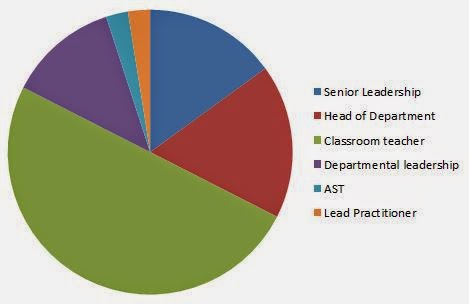
I was worried at one point that lots of people I communicate with about RAG123 appear to be departmental leadership of SLT. It made me wonder whether it is truly sustainable for a mainscale classroom teacher, however 50% of respondents are classroom teachers...
Profile of RAG123 users by job function

85% of respondents first heard about RAG123 via twitter, 5% heard from others in their school, and the final 5% are Rob Williams and I, who did the first trial at our school in November.

Subject coverage
The majority of respondents teach maths (60% if you include those who also teach another subject), and the next big group is science (25% if you include all who mention science). Humanities had 5% and the remaining few are individual teachers of other subjects.
Respondent's subjects
I wouldn't want anyone to draw a conclusion on this that RAG123 only really works for Maths and Science. Notably the two blogs/twitter feeds that have been pushing this idea are mine (Maths based) and Damian Benney's (here - Science based), as such it's hardly surprising that there is a bias here. What I am pleased by though is the fact that other subjects are represented, including the notable "Whole School." I do know from twitter exchanges that RAG123 has been used in MFL, Music, and a some other subjects too - it just happens that they didn't complete the survey.

Part of doing this survey was to collect some info on who was using RAG123 so we could share tips and best practice more directly. Users that included their twitter ID have been sorted by subject and can be found in these lists.

Impact on pupils
That's what we do it for after all!!
An overwhelming 82.5% report an improvement in either effort or attainment, or improvements in both. 10% are new RAG123 users and felt it was too soon to detect any changes, and the remaining 7.5% report no change on the part of the pupils.
Reported impact on pupils following RAG123 introduction
Impact on workload
One of the things I found when I started RAG123 was it improved my workload, I was interested to see what others thought...

Impact RAG123 has had on perceived workload
55% state their workload has decreased, 32.5% say there has been no change, and 12.5% state an increase.

Notably of those reporting increased workload all but one recognise improved pupil effort and attainment (the remaining one response is a "too soon to tell"). In the write in comments all of those with an increased workload are still very positive about RAG123. For example:

"Although I am not perfect at RAG123 and still have to do STAR, it has made marking so much quicker and actually I like doing it."

"My dept and I were sceptical and only did it cos u kept tweeting no negative feedback yet!!!! But we are sold!!"

In terms of where it has had biggest impact, 68% mention marking, 53% mention Dialogue and 60% mention planning (as these don't add to 100% you'll realise that many mention more than one of these!)

Best things about RAG123
This was a free text bit of the survey and the responses ranged from a few words to much more detailed. I could try to pick and choose best bits, but in all honesty it's best just to see the full text cut & pasted in here:


Picking up on misconceptions at source and the value pupils place on such regular marking. Also the way that informs your planning. Impossible to say just one.

Dialogue and relationships with students

Although my work load has increased as I am now taking books in every lesson for checking RAG123, it is a positive increase. I am able to judge how well my lesson has gone straight away. I can use the RAG123 to set targets more effectively and cater better for the individual. As a result DIRT happens every lesson now which I hope will pay off with regard to progress over time and stickability. My students are responding positively to me monitoring their progress so closely and a better dialogue has been established. If I find a smarter way of recording targets in exercise books so there is clear signposting of what is going on for observers, my workload should decrease in the future.

Informs future planning

The simplicity of it and the ease of use.

There are many best things, and the only downside is setting aside the time every lesson to make sure students do their part in it.

Marking is very quick. Pupils marking their own work a real game changer.

I know where everyone is after every lesson and can therefore plan for this in the next lesson. No one slips through the net; misconceptions identified readily (with more certainty than other AFL techniques) - there's nowhere to hide! No chance for bad habits to develop.

Communication with students

You can fully track progress of the whole class. I can identity misconceptions earlier and check students motivation.

Improved dialogue with students

Simple self assessment

It helps me identify what is not making a piece of work G1 and able to then identify where to improve.

Enables frequent marking and formative feedback.

Ability to plan effectively the next lesson and show progress.

quick whole class overview of progress and understanding

The students know that I am looking at the books very regularly and can write me messages that I will read.

I also get them to hand in their books in RAG123 piles so I can start with/spend more time on the students who need more help.

Students are getting used to assessing their own understanding, which I think will help with their revision.

I feel like I know my students better and what they have understood

Makes sure the kids complete their work - being able to keep on top of exactly what they are doing

No more marking guilt and amazing dialogue with students.

The ease, and the fact you know where the kids are after each lesson

quick feedback

Much more informed about planning. Kids love it and whilst I'm not sure any improved attainment is down to this I am convinced improved effort is. Combining it with pupils marking their own/each others work with green pens. We mark in red.

RAG123 is quick and extremely effective. I have mini dialogues with students in their books and can see patterns in behaviours as well and spot misconceptions quickly.

The best thing and what has helped me the most is being able to manage my marking load better. We have weekly book checks, one week yr7 and yr8 and the next week, yr 9 and 10. Before I was always in a mad panic about these. Now I know that although I may not be doing great at following the latest marking policy, my books are marked and feedback is there. (Especially those which I have still kept on top off!!) I know I'm not RAGging properly as I'm trying to squeeze too much feedback in, but it's much better than the paragraphs I wrote before! 

planning for next lesson, allows me to monitor how the students are doing on a regular basis. They self-regulate their effort often.

student focus on their own progress and effort

Checking work after each lesson and before the next one!

The opportunity to have dialogue with pupils. They enjoy doing it too..

Pupils are excited to read and respond to my feedback each day. The impact it's having is worth the extra effort!

It's instant and instantly useful. Supports using LO/SC in all lessons.

I know how everyone is doing and what they need to do to improve or correct misunderstandings.

Quick, easy for both learner and teacher. gives you indication on how class doing, useful for ensuring tailor made lessons.

Regular monitoring, review link to lesson objectives, planning response better informed.

Simplicity, focus on student involvement and it's evidence based system.


The easiness of marking. It helps me to keep on top of it. I now feel a lot more knowledgable about all of my classes.


The worst things about RAG123
For balance I also need to include all of the negatives - this is an unedited cut and paste of "the worst things" - I'll try to address some of the comments in another post:

It can be a pinch if you have parents' evening/meetings after school. Can be overcome though!!

That more people aren't using it!

Nothing! What I want to do is print the RAG123 criteria on a sticker and have it at the front of exercise books. That way I can then have the success criteria on the board linked to 123 which is something I have not yet been doing. I also need to get students to improve their justifications which will come once I have linked the RAG123 criteria to the success criteria.

Colleagues' reactions when you say you mark after every lesson.

Have to remember to mark after every lesson for it to be effective

Nothing

The students who don't mark work or RAG it. 

Those who just go for A2 every time to save actually thinking. Part of the reason that we are going to try red/orange/yellow/green so you are above or below half way.

Having so many books around at school, because I am not tidy and when I lose 1 book (no doubt student put in wrong pile) I have to look for it as I know that they handed it in. (Student then says oh yeah I forgot I have it because I didn't hand it in - grrrrr)

Not sure yet

It doesn't encourage students to make subject specific comments

Needs to be done very regularly.

Sometimes hard to summarise effectively into RAG123 categories

effort grades, personally I don't use them. Grading effort is unreliable.

Not found one yet.

not too sure yet

We also have to give SWANS feedback at least every three weeks, so I have to do that as well as RAG123.

It is sometimes difficult to get the books marked before the next lesson but it's worth it

Some students really don't like it"

Marking the books everyday

Making sure you do it before you go home...

Not sure yet

Still struggle to find time to mark after every lesson - but I put that down to pastoral responsibilities - those pesky kids and parents stop me doing most things when I plan to!!!

If I set homework then I miss a lesson or two with some classes. Maybe I could think about giving separately homework books, but my experience with these has not been good.

The pressure I feel when I've had a bad week and fallen behind. Have five lessons out of six most days, and sometimes struggle to RAG everyday before the next lesson. This is because I've not got it right yet, but I get very stressed and then fall even more behind!!

Need to make more of a glance and RAG123 thing. Have started timing myself now!!!

Doesn't work if you can't keep up checking every lesson - I've fallen victim to this.

students overestimating their understanding

Probably feeling the pressure to check after every lesson, especially when there are after school commitments like parents evenings etc

I have found that it doesn't lend itself to every lesson. 

I sometimes struggle to find the time for the students to do it properly so it ends up being rushed.

Daily expectation! We have probably gone a step too far with it! Setting individual questions, activities even card sorts etc. Viewed as an investment in next lesson rather than a quick response to previous. We are worried about sustainability though.

Sometimes harder to use in English where you're not always working on something as discrete as maths.

Can't think of any. It's easily the best thing I've done in my teaching career.

No real.negatives. some year 11 boys just sat A1 as it relates to breaking bad!

It doesn't record the volume of quality verbal feedback given in maths - but then neither do other written systems, the major issue with ofsted's version of marking and feedback monitoring.

Apathy of some to look at the benefits. Mainly, "you got this from twitter!" What do Ofsted think, well now I know.

I sometimes struggle to mark books every day. Especially on one week where I teach 4 days without a free period or lunchtime or after school.

So there you have it...
There is a bit more analysis to do, and I still need to sort out the top tips bit - there are some gems in there. However I wanted to get this post published this weekend...

Notably for me all of the worst bits are things people struggle with, not reasons to stop. Yes it can be difficult to do every day, yes it takes time for students to respond to it - we need to train them in how to use it and learn how to use it ourselves.

Still sceptical of RAG123? Give it a try!!!


Sunday, 13 April 2014

How do you do RAG123 so quickly?

Whenever people start off with RAG123 they take too long marking. It's not their fault - they're used to taking longer and struggle to do it more quickly. When I say a full set takes 15 minutes I am often greeted with incredulity. I thought I'd prove it... (video run time 3 mins - all the rest is explained...)

(In case of trouble streaming the video you can download a copy here http://bit.ly/RAG123video)

While the set of 26 books marked in the video took me 15 minutes 30 seconds you can see that I write an extra comment/response in almost all of them - for me this is the longest that a RAG123 set ever takes. Sometimes a full set can take less than 10 minutes if I'm not writing extra comments. As part of recording this video I actually filmed myself marking 3 full sets of books - that's 86 books and they were all reviewed in 38 minutes.

Not just about whizzing through books
I really want to emphasise though that RAG123 is actually a whole teaching approach, not just about blasting through a set of books in 10-15mins. The real strength comes from responding to what you see to shape how you approach your next lesson. It informs planning, it makes differentiation better, it helps you to get to know your students better.

Some people may say that "proper AFL in lesson is better than picking things up from reviewing books." To some extent I agree, but this gives an extra method of AFL, and one in which students have nowhere to hide.

Before RAG123 I thought I was quite good at AFL in lesson. I thought I had a good handle on what each student could and couldn't do, and what each student had actually done in lesson. When I started using RAG123 every lesson I found that I was wrong. I had a partial understanding at best, and RAG123 helps me to complete this picture. The insight it gives me helps me to meet the needs of my classes much more effectively than I ever have before. I now dislike planning a lesson until I've reviewed the output of the last one - otherwise it's too much of a guessing game.

Importantly RAG123 shouldn't replace any AFL, or other in class strategy. It also shouldn't be the only form of feedback the students receive.

As always - comments are welcome, please let me know your thoughts...

Saturday, 5 April 2014

RAG123 user survey

I was asked the other day if there was a list of people using RAG123, in order to share best practice and develop it further. There currently isn't such a list... but here's our chance to create one!

If you use RAG123 please could you take 5 mins to complete this form. I'll look to share the results in due course - intention is that we can connect people using RAG123 in the same subject, same phase, etc. And just plain old share good practice...

The form is found here: http://bit.ly/RAG123survey

thanks in advance for taking the time - please share this survey with anyone you know that uses RAG123 - the more input the better...


Blogging birthday post!

My first ever post was published a year ago!! I remember being nervous about putting my thoughts out there for the world to see...

1 year later and this will be my 45th published post. More astounding to me though is that people have actually read any of them! This little blog has now clocked up almost 25,000 visits! I'm flattered that anyone takes time to read this collection of ideas that rattle round my head, so if you're reading this - THANK YOU - I know you don't have to, and this has never been about self promotion.

I was asked recently how many words I'd written as part of this blog - I worked it out the other day and was shocked to find that even excluding this post it's well over 46,000 words! (Note to self - must work on brevity!) When I discovered this massive word count I wondered which words I'd used, so I used Wordle to summarise it - I was quite pleased with the result...

Alongside this I've found myself with almost 800 followers on twitter - which also amazes me!

So what is it all about?
During the year I've blogged about various topics, from leadership to homework, to SOLO, to marking - you can find links to these topics on the right of the blog page. More recently I've been a bit preoccupied with RAG123 marking, which has dominated posts since November, but frankly it's such a powerful bit of practice I think it as deserved the priority I've given to it. (by the way - if you've not heard of RAG123 then have a look at my posts - I promise you won't regret it!)

As an indirect result of twitter and blogging, and the reflective, innovative practice that it encourages my department and I have:

  • Developed feedback and marking processes
  • Innovated RAG123
  • Created departmental CPD open days
  • Written on just about every surface in the classroom with magic whiteboard, chalkpens, etc.
  • Analysed summative tests to make them formative using various tools.
  • Created graffiti walls for revision
  • Made question grenades
  • Developed the use of QR codes, bitly links and videos for flipped learning in our department
  • Created maths plasters
  • Developed seating plan formats to show student data easily
  • Introduced SOLO to our school
  • Used formats to share learning objectives with KS5
And there are loads more things - I'm amazed how long that list is already.


Has it been worth it?
Without a doubt yes! 

Of course it takes time to write posts - sometimes more than others, but it's actually never felt like a drag. I've also surprised myself in that I've never once struggled to find a topic to write about - stuff just happens and I think "that'll make a good blog post." I wrote a post (here) in June considering why I had bothered getting involved in blogging and twitter and whether it was worth it. Having read back over that post I don't think I can improve on it, I've honestly never looked back since starting.

It has been a bit of a journey this year; discovering twitter and blogging as a CPD tool has been a massive eye opener. It's transformed my practice in many ways, and helped me to lead my department with new ideas. Comments and feedback from the blog and from tweets have helped me to improve my classroom practice, and writing about it has helped me to be more reflective about it too. Furthermore being on twitter has helped me to be more connected to the wider world of education than ever before. I'll continue blogging and using twitter because it makes me better at my job.

A new phase begins...
This week has been fairly momentous for me. In addition to the anniversary of blogging I was successful in an interview on Monday, and will now be joining my current school's SLT as an Assistant Headteacher from September.

I can honestly say that the combination of blogging and twitter helped me to be a much more credible candidate for a role on the school's SLT than I would have been without these connections. It really came home to me when I sat down to prepare for the interview and realised that I was already fully up to speed with latest thinking about lesson observations, assessment structures, learning theories, inspection frameworks, etc. In fact in some aspects I was more in touch than the majority of the existing SLT - all through keeping up to date with my twitter feed and reading other people's blogs!

I was also able to ask for advice and tips on my application for this SLT post from contacts in my personal learning network who I didn't know at all last year! There were a couple in particular who helped by proof reading my application form and offered encouragement and suggestions. I'll not name you in case you get inundated by requests from others, but you know who you are and thank you!

I fully intend to keep blogging as I make the transition from middle to senior leadership, and hope that it continues to shape my practice, and contribute to the future of my school and its students.

So after all that I think this post is really a thank you to anyone who has ever taken the time to read, comment, tweet or follow as part of my journey in the last year. I've certainly enjoyed it and think I'm a better teacher and leader as a result... I hope you've found some of it useful!

Here's to another year - I wonder what will develop in the next 12 months...!